
Busan + Gyeongju History Tour: A 3-Day, 2-Night Deep Dive
From Busan's port-city history to the millennium-old Silla capital of Gyeongju — a deep dive for travelers who love museums and heritage sites.
Itinerary Stops
- 1
Busan Modern History Museum
This building once housed the Busan branch of the Oriental Development Company during Japanese colonial rule, and later served as the American Cultural Center — living modern history in itself. Exhibits trace Busan from its days as a treaty port through colonial rule to the US military government era, making it a great 'intro course' for the whole trip.
View on map → - 2
Provisional Capital Memorial Hall
After the Korean War broke out, Busan served as South Korea's provisional capital from 1950 to 1953. This building was originally the Gyeongsangnam-do governor's residence and later President Syngman Rhee's temporary residence. Exhibits recreate wartime civilian life, making this a key stop for understanding what makes Busan unique.
View on map → - 3
40 Stairs Culture Tourism Theme Street
During the Korean War, many displaced families and refugees who fled south gathered around these stairs to scrape by and search for lost relatives. Today, nostalgic statues and small exhibits line the steps, making for an evocative daytime stroll.
View on map → - 4
Choryang Ibagu-gil
'Ibagu' means 'story' in Busan dialect. This alley preserves traces of postwar working-class life, including a red mailbox installation honoring poet Yu Chi-hwan, and a monorail up 168 steps to a lookout over the port and city.
View on map → - 5
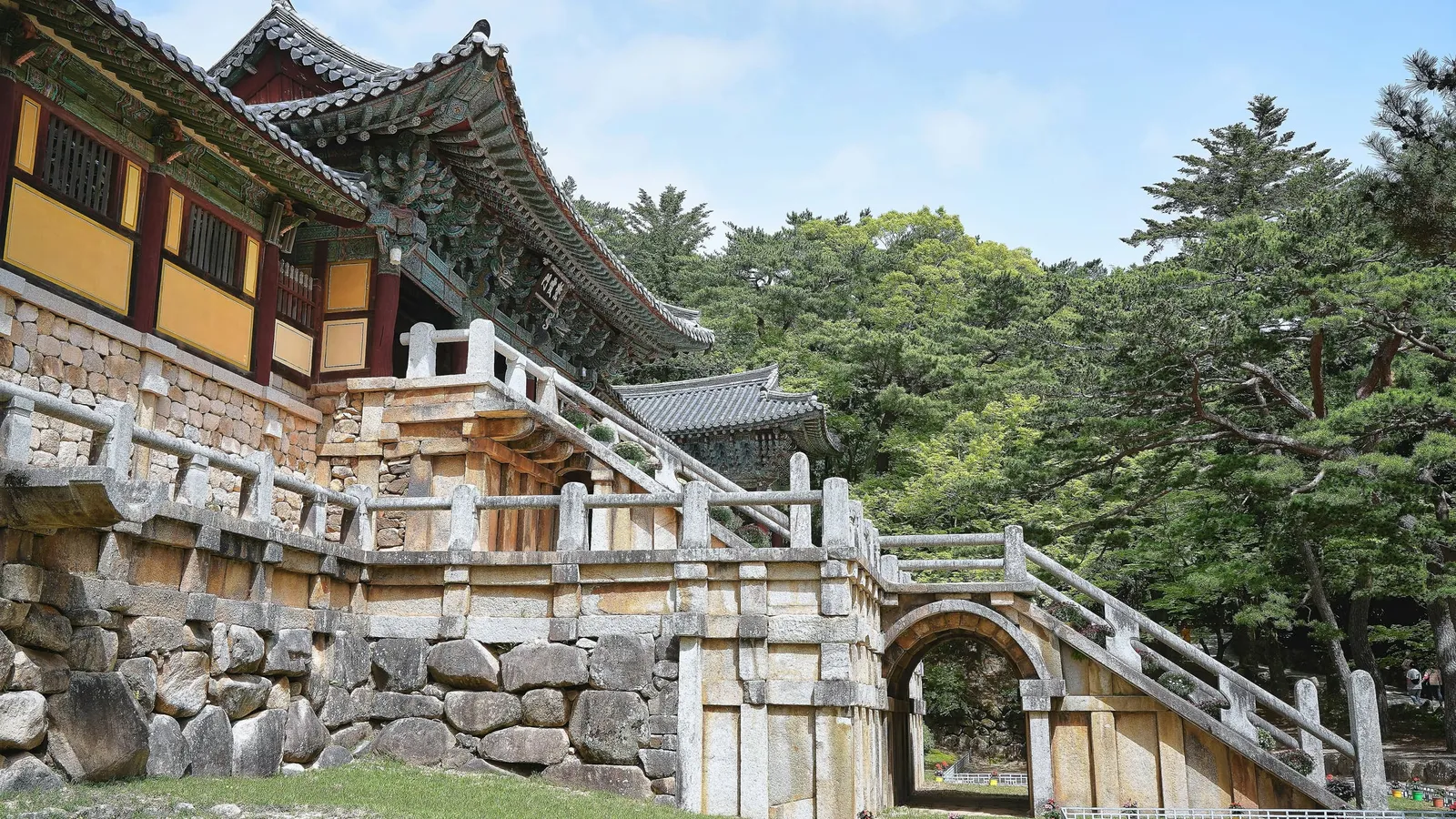
Bulguksa Temple
A UNESCO World Heritage Site and a masterpiece of Silla Buddhist art. The side-by-side Dabotap and Seokgatap pagodas are an iconic scene straight out of Korean history textbooks.
View on map → - 6
Seokguram Grotto
Another UNESCO World Heritage Site alongside Bulguksa, set halfway up Mt. Toham. The carving of the seated Buddha at its center is considered a pinnacle of East Asian Buddhist art. Best paired with Bulguksa, about a 15-minute drive apart.
View on map → - 7
Daereungwon Tomb Complex & Cheomseongdae
Daereungwon is a cluster of Silla royal tombs, including Cheonmachong, which you can enter to view excavated artifacts. Cheomseongdae is one of the oldest surviving astronomical observatories in East Asia. The two sites sit close together, ideal for a leisurely stroll through both in one go.
View on map → - 8
Donggung Palace & Wolji Pond (Anapji)
The ruins of a Silla royal detached palace. By day it's a quiet pond-side walk, but at night the buildings reflect on the water for one of Gyeongju's most famous night views — a fitting final stop before heading back to Busan.
View on map → - 9
UN Memorial Cemetery
The world's only United Nations military cemetery, holding soldiers from multiple nations who gave their lives defending Korea during the Korean War. The pine-shaded, solemn grounds stand in stark contrast to the relaxed city around it.
View on map → - 10
Chungnyeolsa Shrine
A shrine honoring Song Sang-hyeon, the Dongnae magistrate, and other loyal officials who died resisting Japanese forces during the 1592 Imjin War. Its solemn architecture makes it an important stop for understanding centuries of Korea-Japan history.
View on map → - 11
Dongnaeeupseong Fortress
A Joseon-era local administrative fortress and the front line where Busan's soldiers and civilians resisted the Japanese invasion right after the 1592 Imjin War broke out. Climb the surviving walls and east gate tower to take in the historical terrain.
View on map →
From the turbulent history of a modern port city to the glory of a thousand-year Silla dynasty — this is the widest time span you’ll cover on any Busan trip.
If you’ve already done Busan’s beaches and had your fill of sashimi, this route is for something different. Day one steps into Busan’s memory as a “provisional capital” and modern treaty port; day two hops on the KTX to Gyeongju to collect three World Heritage Sites in a single day; day three returns to Busan for sites where the Joseon dynasty resisted Japanese invasion. You don’t need a history degree — just curiosity about what this city has lived through.
Itinerary at a glance
| Day | Theme | Key spots |
|---|---|---|
| Day1 | Busan’s modern history & Korean War memory | Busan Modern History Museum・Provisional Capital Memorial Hall・40 Stairs Culture Tourism Theme Street・Choryang Ibagu-gil |
| Day2 | Gyeongju day trip: the millennium-old Silla capital | Bulguksa Temple・Seokguram Grotto・Daereungwon & Cheomseongdae・Donggung Palace & Wolji Pond (night view) |
| Day3 | The Joseon dynasty & Korean War fallen | UN Memorial Cemetery・Chungnyeolsa Shrine・Dongnaeeupseong Fortress |
Day1: Busan’s modern history & Korean War memory
1. Busan Modern History Museum
This building once housed the Busan branch of the Oriental Development Company during Japanese colonial rule, and later served as the American Cultural Center — living modern history in itself. Exhibits trace Busan from its days as a treaty port through colonial rule to the US military government era, making it a great “intro course” for the whole trip. 📍 View on map →
2. Provisional Capital Memorial Hall
After the Korean War broke out, Busan served as South Korea’s provisional capital from 1950 to 1953. This building was originally the Gyeongsangnam-do governor’s residence and later President Syngman Rhee’s temporary residence. Exhibits recreate wartime civilian life, making this a key stop for understanding what makes Busan unique. 📍 View on map →
3. 40 Stairs Culture Tourism Theme Street
During the Korean War, many displaced families and refugees who fled south gathered around these stairs to scrape by and search for lost relatives. Today, nostalgic statues and small exhibits line the steps, making for an evocative daytime stroll. 📍 View on map →
4. Choryang Ibagu-gil
“Ibagu” means “story” in Busan dialect. This alley preserves traces of postwar working-class life, including a red mailbox installation honoring poet Yu Chi-hwan, and a monorail up 168 steps to a lookout over the port and city. 📍 View on map →
Day2: Gyeongju day trip — the millennium-old Silla capital
From Busan, Gyeongju is only about 30 minutes to an hour away by KTX or intercity bus, making it perfect for a day trip. Gyeongju was the capital of the Silla dynasty (57 BCE–935 CE) for nearly a thousand years, and World Heritage Sites are scattered across the city — often called “the museum without walls.”
1. Bulguksa Temple
A UNESCO World Heritage Site and a masterpiece of Silla Buddhist art. The side-by-side Dabotap and Seokgatap pagodas are an iconic scene straight out of Korean history textbooks. 📍 View on map →
2. Seokguram Grotto
Another UNESCO World Heritage Site alongside Bulguksa, set halfway up Mt. Toham. The carving of the seated Buddha at its center is considered a pinnacle of East Asian Buddhist art. Best paired with Bulguksa, about a 15-minute drive apart. 📍 View on map →
3. Daereungwon Tomb Complex & Cheomseongdae
Daereungwon is a cluster of Silla royal tombs, including Cheonmachong, which you can enter to view excavated artifacts. Cheomseongdae is one of the oldest surviving astronomical observatories in East Asia. The two sites sit close together, ideal for a leisurely stroll through both in one go. 📍 View on map →
4. Donggung Palace & Wolji Pond (Anapji)
The ruins of a Silla royal detached palace. By day it’s a quiet pond-side walk, but at night the buildings reflect on the water for one of Gyeongju’s most famous night views — a fitting final stop before heading back to Busan. 📍 View on map →
💡 History note: In the 7th century, Silla allied with Tang China to conquer Baekje and Goguryeo, unifying most of the Korean peninsula for the first time. Gyeongju then remained the peninsula’s political and cultural center for nearly a thousand years.
Day3: The Joseon dynasty & Korean War fallen
1. UN Memorial Cemetery
The world’s only United Nations military cemetery, holding soldiers from multiple nations who gave their lives defending Korea during the Korean War. The pine-shaded, solemn grounds stand in stark contrast to the relaxed city around it. 📍 View on map →
2. Chungnyeolsa Shrine
A shrine honoring Song Sang-hyeon, the Dongnae magistrate, and other loyal officials who died resisting Japanese forces during the 1592 Imjin War. Its solemn architecture makes it an important stop for understanding centuries of Korea-Japan history. 📍 View on map →
3. Dongnaeeupseong Fortress
A Joseon-era local administrative fortress and the front line where Busan’s soldiers and civilians resisted the Japanese invasion right after the 1592 Imjin War broke out. Climb the surviving walls and east gate tower to take in the historical terrain. 📍 View on map →
Trip summary
This route moves “from near to far, from modern to ancient”: day one starts with the late-19th-century port opening and 20th-century Korean War memory, which is easier to connect with emotionally; day two leaps back to the millennium-old Silla capital, a completely different scale of time; day three returns to the Joseon dynasty and the 16th-century Imjin War battlegrounds, filling in the gap in between. String the three days together, and you’ve walked through two thousand years of the Busan region’s history.
A few friendly notes
- Chungnyeolsa Shrine and the UN Memorial Cemetery are solemn sites — please dress neatly and keep your voice down.
- Gyeongju’s sights are spread out, so a local sightseeing bus or private day tour will save far more time than transferring between city buses.
- Some areas of Bulguksa and Seokguram involve a fair number of steps, so comfortable shoes make things much easier.
Before you go
Get these sorted before departure and the trip will run much smoother:
- 📶 Internet: Grab an eSIM or pocket WiFi in advance — signal in Gyeongju’s outskirts can be less reliable than downtown.
- 🚗 Airport transfer: A pickup service from Gimhae Airport into the city saves the hassle of hauling luggage while finding your way.
- 🎫 Transit: For the Gyeongju day trip, booking a tour that includes transportation will save more time than doing it independently.
- 🧳 Luggage delivery: A same-day delivery service between Busan Station, the airport, and your hotel means no dragging bags along on the Gyeongju day.
Where to stay
For the two nights of this history tour, we’d recommend staying around Busan Station/Jung-ang-dong — close to the modern-history sights on Day1 and Day3 and to Busan Station itself, and convenient for catching an early KTX to Gyeongju on Day2.
- Business hotels near Busan Station: The most convenient for transit, so you won’t be rushing to catch the train to Gyeongju.
- Nampo-dong/Jung-ang-dong hotels: Walking distance to the Busan Modern History Museum and 40 Stairs, with Gukje Market nearby for the evening.
- Check hotel prices near Busan Station on Trip.com →
Recommended tours & tickets
- Gyeongju World Heritage day tour (transport included): Skip the driving and transfers — cover Bulguksa, Seokguram, and Daereungwon in a single day. View Gyeongju tours on KKday →
- Prefer a guided group tour over doing it yourself? See our comparison of the 3 most popular Gyeongju day tours.
For more live discount codes, see 👉 Busan Discount Code Roundup
This article contains affiliate links. Booking through them costs you nothing extra, and we earn a small commission that helps run the site. See our affiliate disclosure for details.
Recommended Hotels

Hotel Foret Premier Nampo
A newer boutique-style hotel steps from BIFF Square, about 5 minutes' walk from Jagalchi Market and Gukje Market, with compact modern rooms.
US$57 - US$75 / night
Check rates on Trip.com💡 Some links on this page are affiliate links. If you complete a booking through them, we may earn a commission at no extra cost to you. Affiliate Disclosure
💰 Check before you book
Before you go, check the latest KKday discount codes — one code can shave a meaningful amount off your booking.
See the latest discount codes →💡 Some links on this page are affiliate links. If you complete a booking through them, we may earn a commission at no extra cost to you. Affiliate Disclosure